
Claude Opus 5.5: Fable-level work for 40% less

Kash Gh
· Published · Updated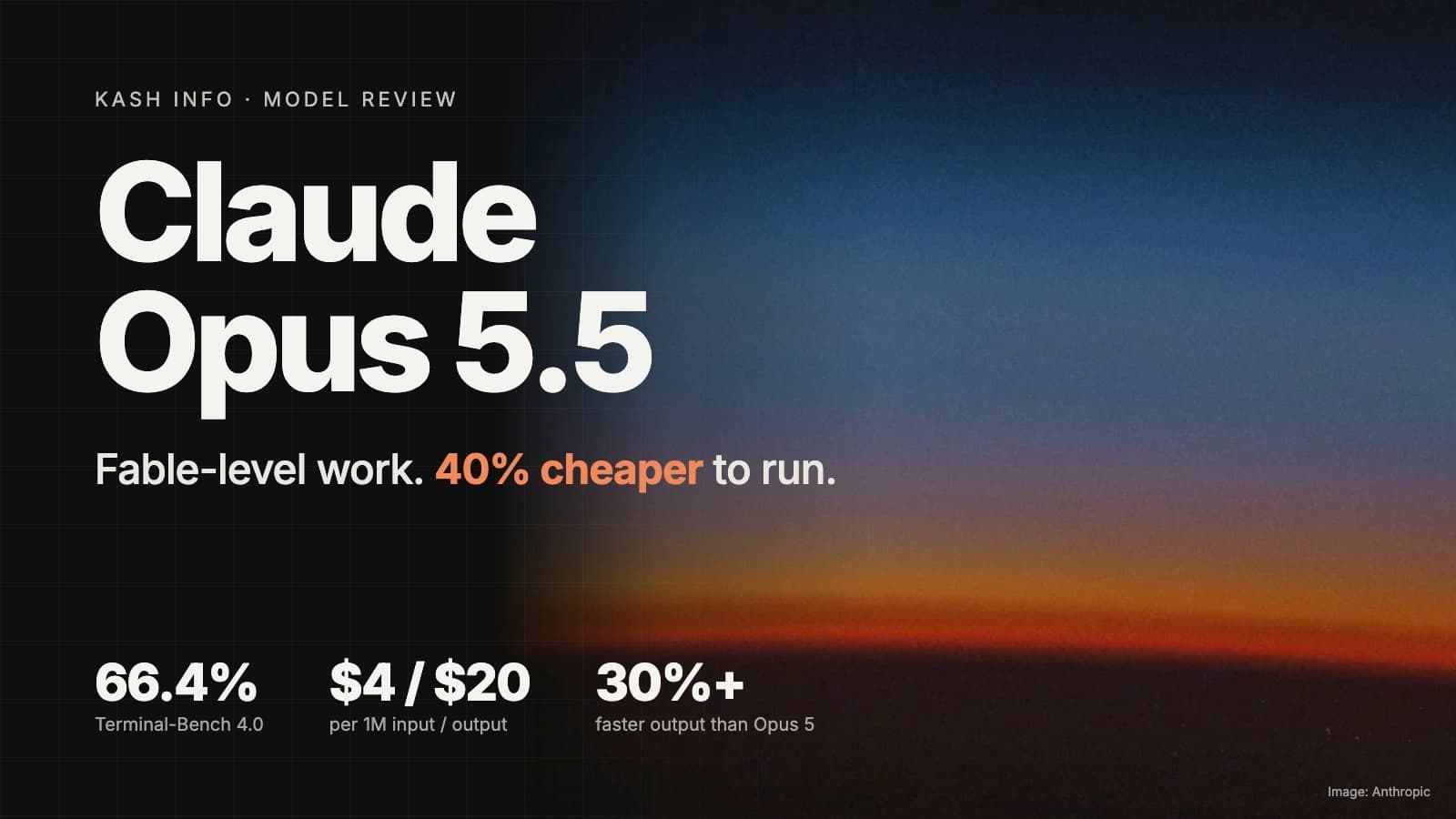
Anthropic released Claude Opus 5.5 today. The pitch fits in one line: it does most of what Claude Fable 5.1 does and costs 40% less to run than Opus 5. If you pay for Claude by the token, or you keep hitting the weekly cap on a subscription, that line matters more than any benchmark.
I watched Chase AI's breakdown of the launch, read Anthropic's announcement, and pulled the numbers into charts you can scan in a minute. Below you'll find what changed, where Opus 5.5 wins, where it loses, and which effort setting I'd pick.
The headline numbers
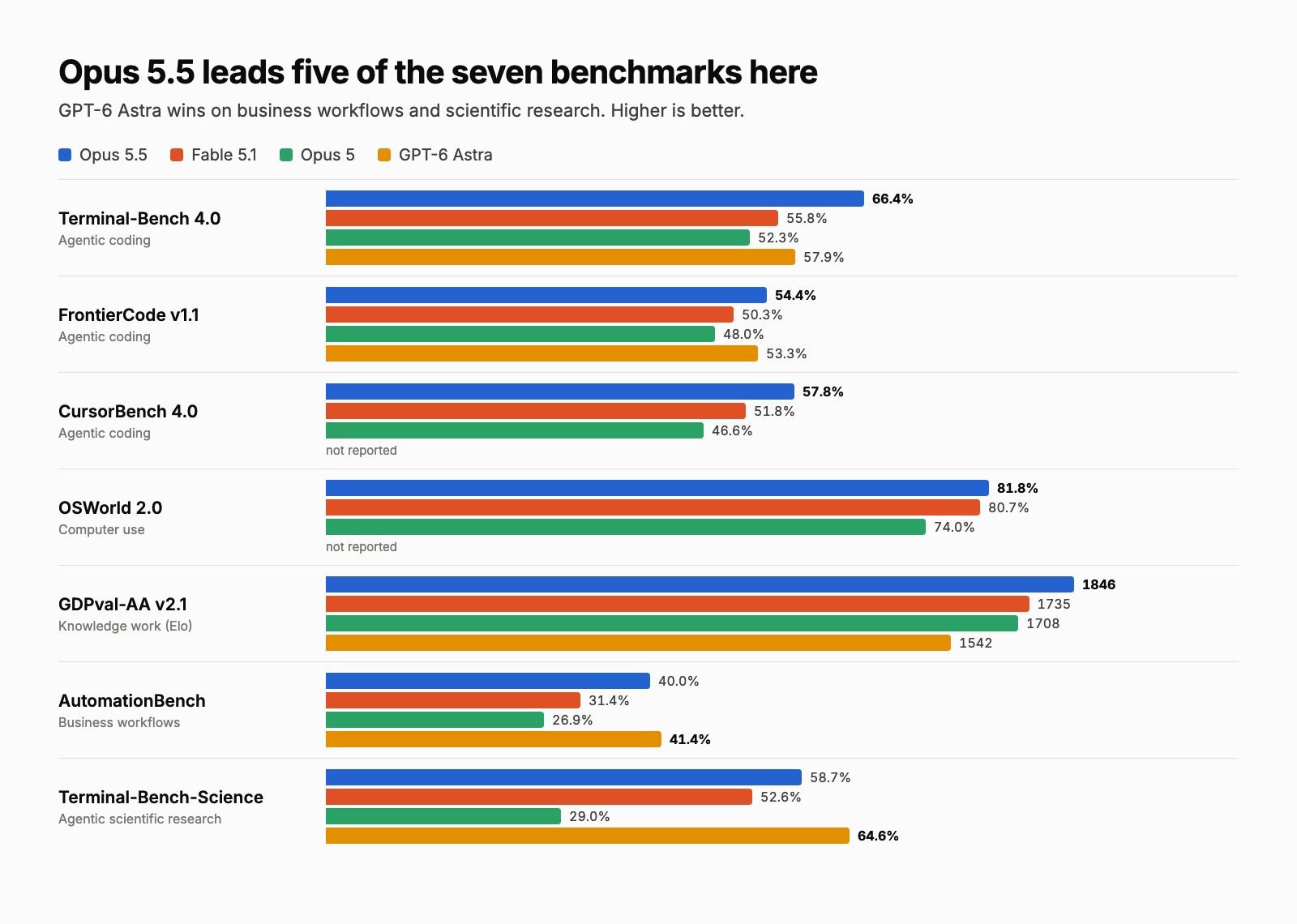
Anthropic compared Opus 5.5 against Fable 5.1, Opus 5, OpenAI's GPT-6 Astra and GPT-5.6 Sol. Opus 5.5 posts the top score on five of the seven benchmarks in the chart below, including all three agentic coding tests.
GPT-6 Astra still wins two:
AutomationBench (business workflows): Astra scores 41.4% to Opus 5.5's 40.0%. Zapier ran this one without fallback models, so every time a safeguard stepped in, the task counted as a failure.
Terminal-Bench-Science (agentic scientific research): Astra leads 64.6% to 58.7%.
Against Fable 5.1 the gap runs one way. Opus 5.5 beats it on every row, by about 10 points on Terminal-Bench 4.0 and 6 points on CursorBench. Anthropic adds a caveat worth repeating: in its own daily use, the gap between the two models looks narrower than these scores suggest.
Effort levels change the math
A price per million tokens tells you little if a model burns three times the tokens to finish the job. The useful chart plots score against cost per task at each effort level, from low to max.
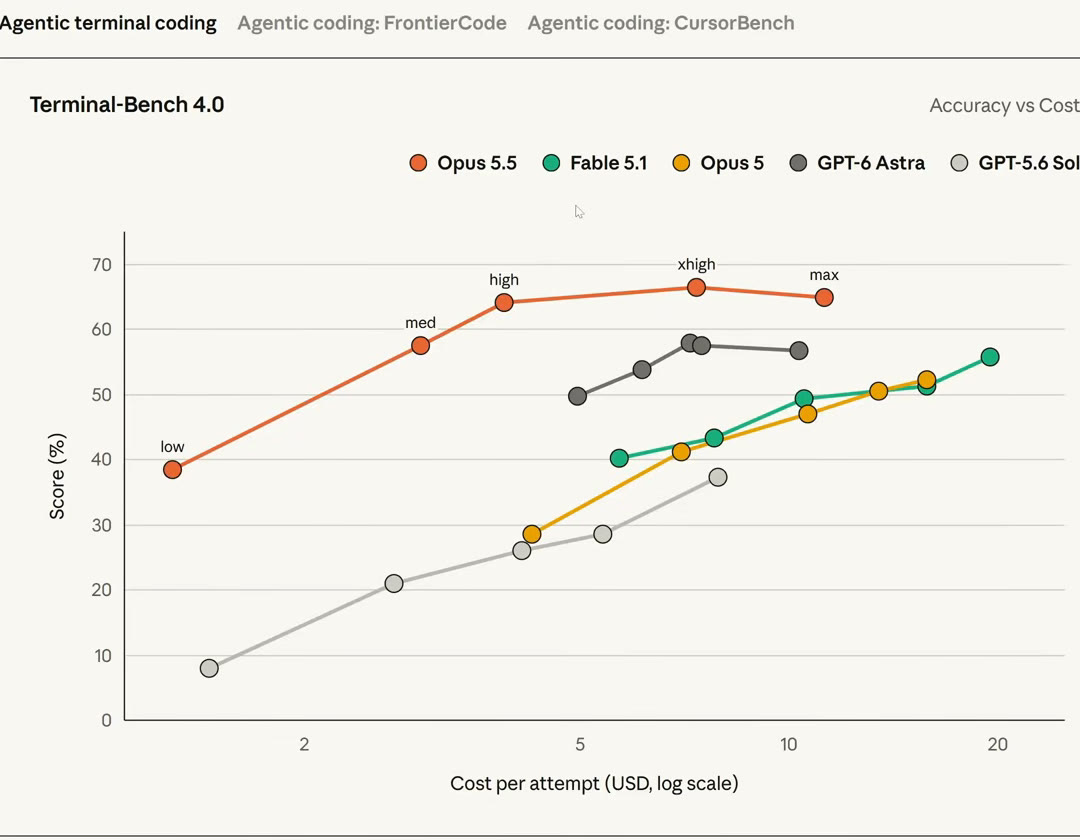
Opus 5.5 (the orange line) sits above every other model at every price point. Chase read the numbers off the chart:
At high effort, Opus 5.5 scores 64.2% for about $3.88 per attempt.
GPT-6 Astra at high costs about $7.21, close to double.
Fable 5.1 at high scores 49.4% and costs about $10.50.
The same chart shows diminishing returns past high. Opus 5.5 at max scores 64.8%, a 0.6-point gain for almost four times the cost. FrontierCode tells the same story more bluntly: medium effort scores 54.6% and max scores 54.4%, and medium costs six to seven times less.
Anthropic's own summary backs this up. At its default effort, Opus 5.5 beats Opus 5 at max effort for about a fifth of the cost, and it matches Astra on Terminal-Bench for about 40% of the cost.
My takeaway: start on medium, move to high for hard problems, and treat max as a last resort.
Cheaper on every line of the price sheet
Opus 5.5 costs $4 per million input tokens and $20 per million output tokens, 20% below Opus 5. Cache reads fell 60%, from $0.50 to $0.20. That cut matters most, because cache reads make up most of the bill for agentic and coding work.
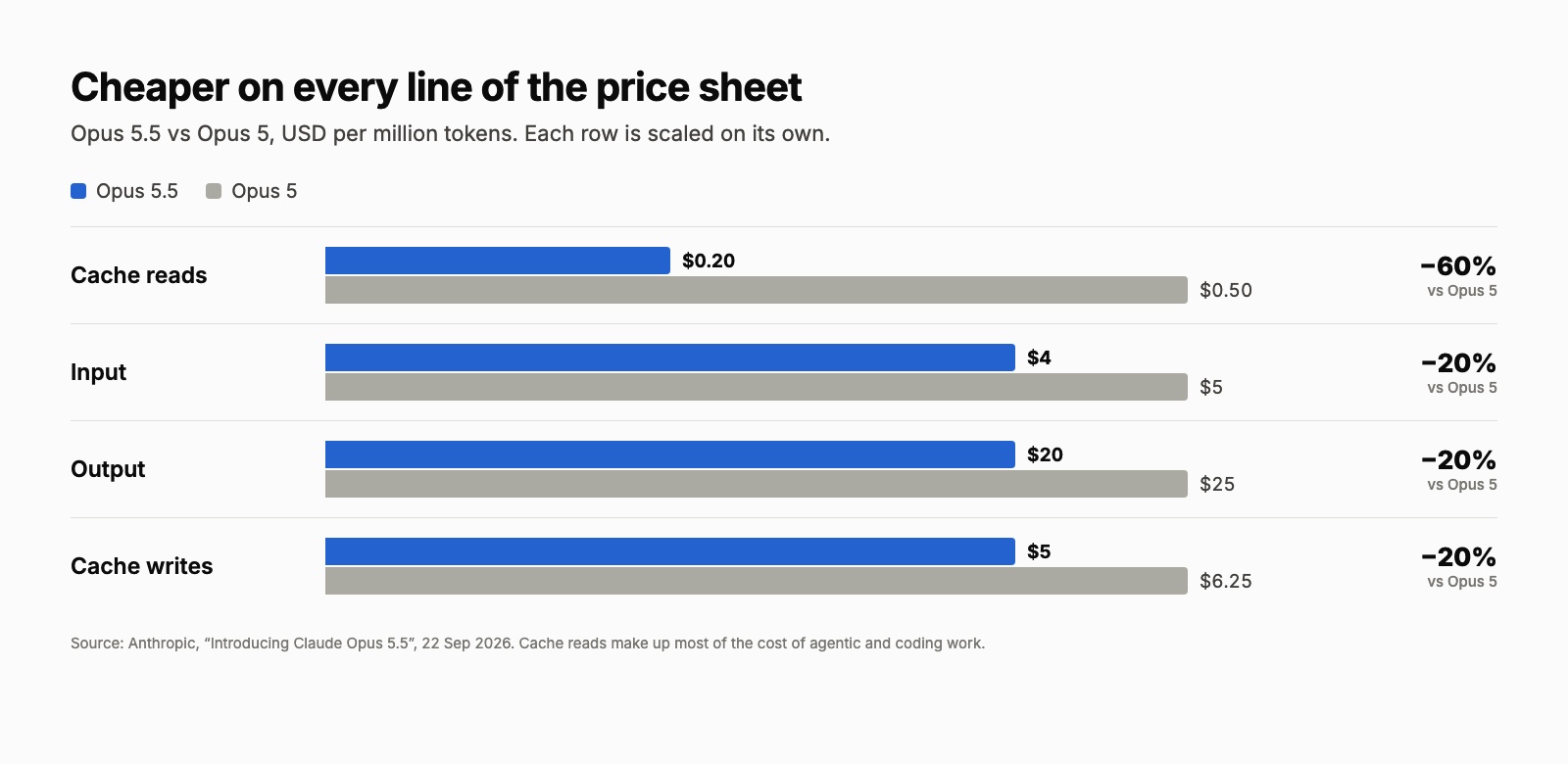
For comparison, Chase puts Fable 5.1 and GPT-6 Astra at $10 input and $50 output per million. Anthropic also says Opus 5.5 generates output more than 30% faster than Opus 5. Fast mode in Claude Code runs up to 2.5x faster at $8 input and $40 output.
It finally writes like a person
Opus 5 had a reputation. It packed answers with jargon and odd phrasing until you had to reread them twice. Anthropic heard the complaints. Opus 5.5 puts the key information first, uses less jargon, and follows the writing rules you give it.
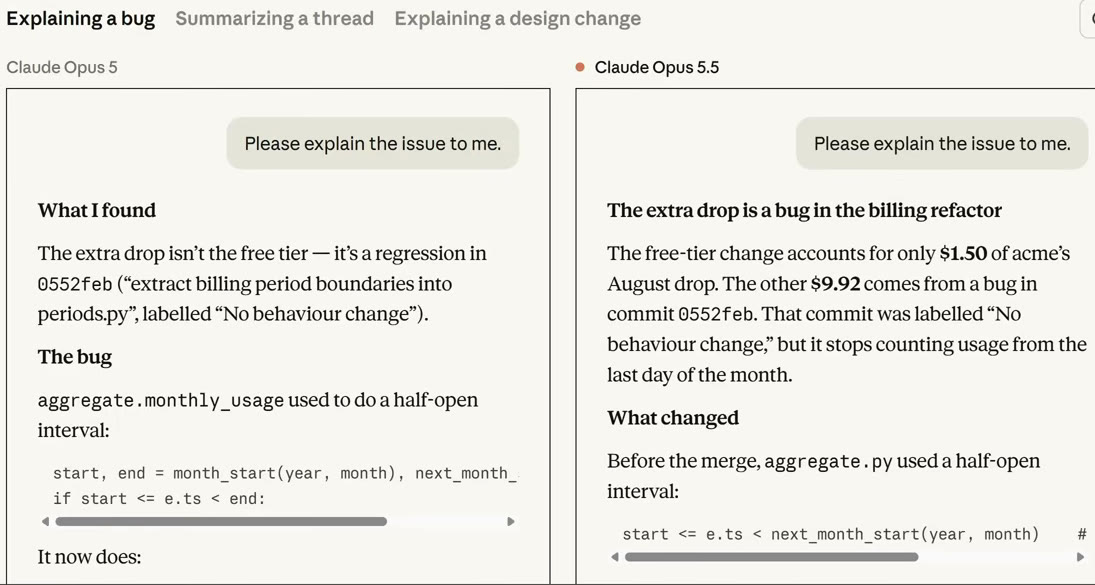
In the example above, both models find the same billing bug. Opus 5 opens with a commit hash and a function name. Opus 5.5 opens with the answer: $1.50 of the drop came from the free tier and $9.92 came from the bug. You can act on the second version without scrolling.
Anthropic's early testers report the same thing. Box saw answers 40% less verbose with no loss in accuracy, and Ramp said its design specs came out usable with minimal edits.
Safeguards borrowed from Fable
Opus 5.5 ships with the same class of safeguards as Fable 5.1:
Cybersecurity. You can still find and fix bugs in your own code. Most other security tasks get rerouted to Opus 4.8. Verified security practitioners can apply to Anthropic's Cyber Verification Program, which will soon include Opus 5.5.
Biology. Opus 5.5 uses Fable 5.1's biology safeguards. Labs and pharma teams can apply to the Life Sciences Verification Program for fuller access.
Distillation. Preserved thinking stops API users from editing Claude's earlier context to pull out its reasoning. It applies to API accounts created on or after August 31, 2026.
Anthropic also calls Opus 5.5 its best-behaved model yet on its automated alignment audit. In a new containment test, it tried to cross boundaries about 85% less often than Opus 5.
What it means if you pay for a Claude plan
Chase made the point that hits closest to home. Anthropic plans cap Fable at half your weekly allowance, so the second half has meant falling back to Opus 5. With Opus 5.5 behind that cap, the second half of your week now runs on a model that performs close to Fable.
Anthropic is also raising five-hour usage limits on Pro, Max, Team and seat-based Enterprise plans. Subscribers get a rate limit reset they can save and spend when they choose.
Opus 5.5 is live today on the Claude apps, the Claude Platform (claude-opus-5-5), AWS, Google Cloud and Microsoft Azure. Sonnet 5.5 and Haiku 5.5 follow in the coming weeks.
Will it hold up?
Benchmarks and launch-day quotes only go so far. The real test comes from a few weeks of daily work. Chase points out that some Opus sessions ran on 5.5 in the week before launch, and people on X posted strong results from them. That's a good early sign.
I'll run it through my own projects and report back here. Tell me in the community what you see.
Sources
Video: Opus 5.5 Crushes Fable & Astra by Chase AI. Screenshots used with credit.
Anthropic: Introducing Claude Opus 5.5